

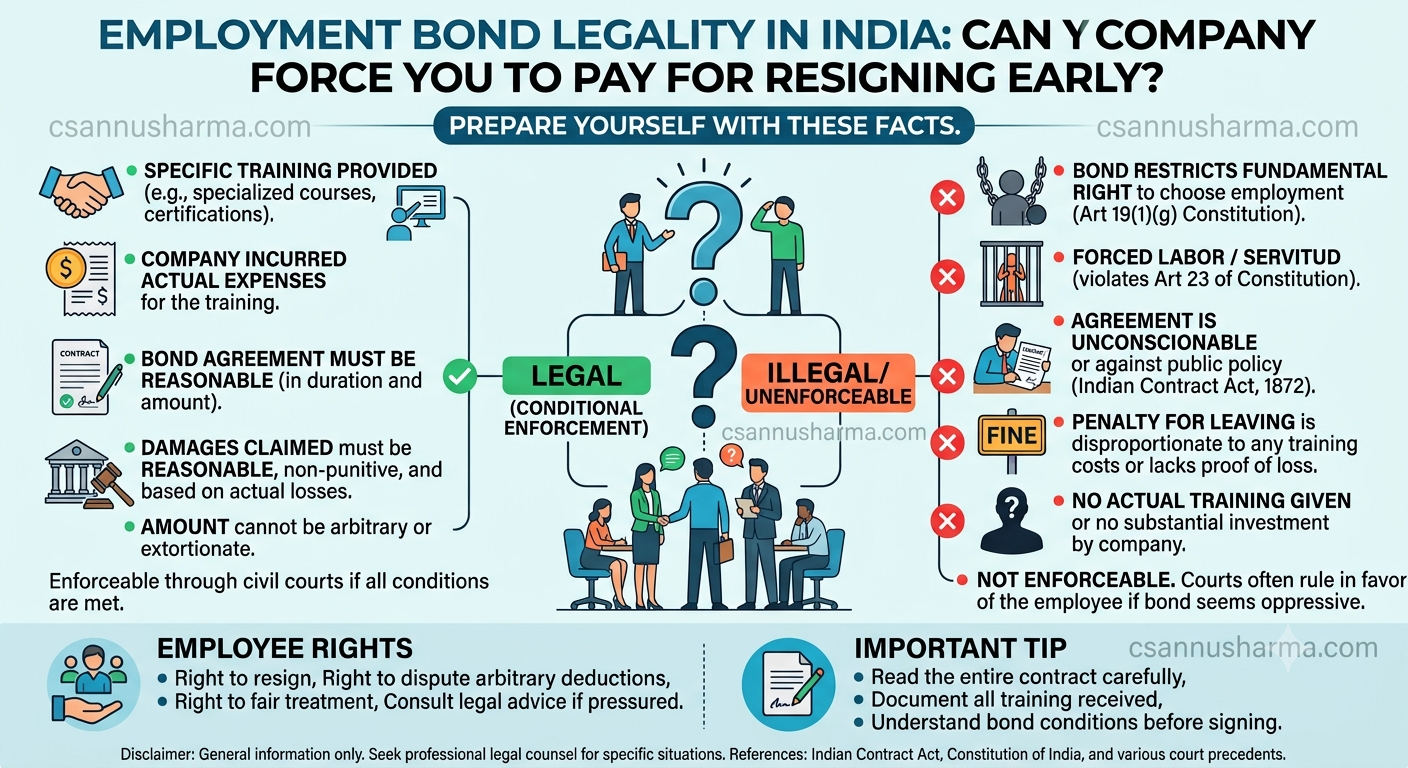
Employment Bond Legality in India : Can Your Company Force You to Pay for Resigning Early?: If you’ve ever signed a job offer that included a clause saying you must “serve a minimum period of 1-3 years or pay a penalty,” you’ve signed an employment bond. Thousands of employees in India — especially in IT, aviation, healthcare, and manufacturing — face this exact question every year: is this even legal, and do I really have to pay?
This guide breaks down the law in plain language, so you know exactly where you stand before you resign.
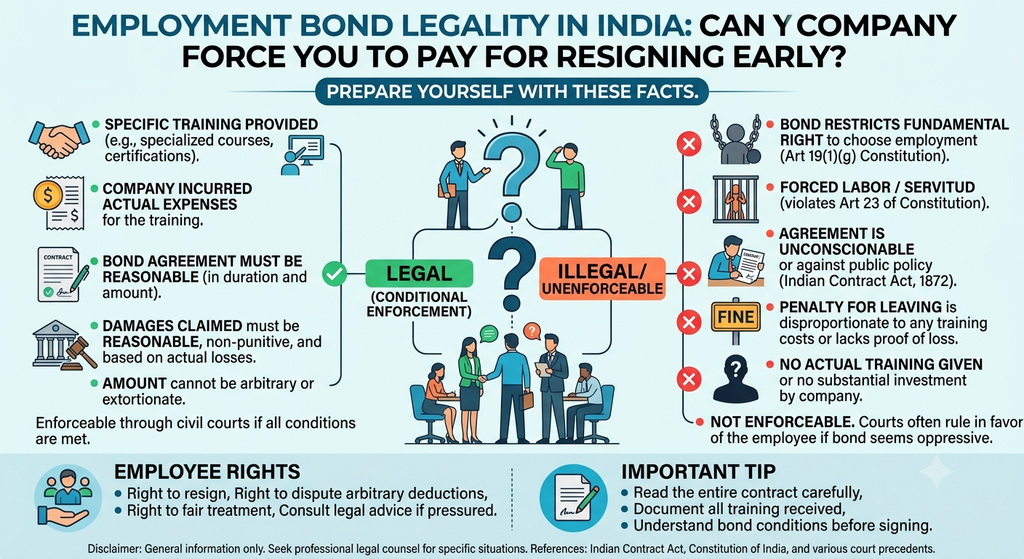
What Is an Employment Bond?
An employment bond is a clause (sometimes a separate agreement) where an employee agrees to:
- Work for a company for a minimum fixed period (commonly 1-3 years), and
- Pay a penalty or reimburse training costs if they resign before that period ends.
Companies use bonds mainly when they’ve invested heavily in training, certifications, or relocation for a new hire — IT firms training freshers, airlines training pilots/cabin crew, and hospitals sponsoring medical staff are the most common examples.
Are Employment Bonds Legal in India?
Yes, but with important limits. This is the part most employees get wrong — a bond isn’t automatically enforceable just because you signed it.
The core issue comes down to Section 27 of the Indian Contract Act, 1872, which says any agreement that restrains a person from carrying on a lawful profession, trade, or business is void. Courts have repeatedly held that you cannot be legally stopped from resigning or joining another employer — no bond can force you to keep working somewhere against your will.
However, courts have also consistently upheld one specific type of clause: a reasonable reimbursement clause. If your employer genuinely spent money training you (certifications, courses, relocation, sponsorship), asking you to repay a reasonable, proportionate amount if you leave early is generally considered valid — because that’s compensation for a real loss, not a restriction on your right to work.
In short:
- ❌ A company CANNOT force you to keep working or physically stop you from resigning.
- ✅ A company CAN ask you to pay back reasonable, documented training/relocation costs if you leave before the agreed period.
- ❌ A wildly high, punitive penalty (say, ₹5 lakh for a ₹20,000 training course) is very likely unenforceable in court, because Indian courts strike down penalty clauses that don’t reflect genuine loss.
Table of Contents
Are Employment Bonds Legal in India? A Detailed Legal Breakdown
The Core Legal Framework
Three legal sources govern whether an employment bond holds up in India:
1. Section 27, Indian Contract Act, 1872
This is the foundation. It states that any agreement restraining a person from exercising a lawful profession, trade, or business is void — with very narrow exceptions (like sale of goodwill in a business). Courts have consistently interpreted this to mean: no employer can legally stop you from resigning or joining a competitor, no matter what the bond says.
2. Section 74, Indian Contract Act, 1872
This section deals with liquidated damages and penalty clauses. It says that if a contract specifies a penalty for breach, the affected party can only claim “reasonable compensation” not exceeding the amount named — not an automatic right to the full penalty figure. This is the section courts use to strike down or reduce inflated bond penalties that don’t reflect genuine loss.
3. Judicial precedent
Indian courts (including landmark cases like Superintendence Company of India v. Krishan Murgai and various High Court rulings on training bonds) have repeatedly drawn the same line:
- Restraining someone from working = void
- Recovering genuine, proportionate costs already incurred = enforceable
The Legal Test Courts Actually Apply
When a bond dispute reaches court, judges typically assess:
| Factor | What Courts Look For |
|---|---|
| Genuine cost | Was money actually spent on training/certification/relocation? (Invoices, receipts) |
| Proportionality | Does the penalty match the real cost, or is it inflated as a “punishment”? |
| Reasonableness of duration | Is the bond period (1-2 years typical) reasonable relative to the investment made? |
| Free consent | Was the clause clearly explained, or hidden in fine print/signed under pressure? |
| Restraint vs. reimbursement | Does the clause simply ask for money back, or does it try to prevent you from working elsewhere? |
If a bond fails the proportionality or genuine-cost test, courts routinely reduce the penalty — sometimes to a small fraction of what was originally claimed, or void it entirely.
Types of Joining Agreements / Employment Bonds in India
Not all bonds are the same — the type matters a lot for enforceability. Here’s a breakdown your readers will find genuinely useful (and this section alone can be a great standalone article):
1. Training Bond
What it is: Common in IT, aviation, and manufacturing. Employer pays for a structured training program (technical certification, pilot training, machine operation) before or right after joining, and asks the employee to serve a minimum period afterward.
Enforceability: Generally the strongest and most defensible bond type, since training cost is easy to document and directly tied to employee benefit.
2. Relocation/Sponsorship Bond
What it is: Used when a company relocates an employee (often internationally) or sponsors a visa, covering flights, accommodation, and visa costs.
Enforceability: Enforceable if costs are itemized and proportionate; courts are sympathetic here since relocation costs are concrete and verifiable.
3. Study/Higher Education Sponsorship Bond
What it is: Common in banking, PSUs, and healthcare — employer funds an employee’s higher education (MBA, specialization, certification course) in exchange for a service commitment afterward (often 2-5 years).
Enforceability: Usually upheld if the bond period is reasonable relative to course cost and duration — but very long bonds (5+ years) for modest course fees have been struck down as excessive.
4. Minimum Service Period Bond (No Specific Cost Attached)
What it is: A generic clause simply saying “you must serve X years or pay ₹Y,” with no clear link to any actual company expense.
Enforceability: Weakest type. Since there’s no documented cost being recovered, this often looks like a pure restraint on trade under Section 27 — highly challengeable, especially if the penalty amount seems arbitrary or punitive.
5. Notice Period Buyout Clause
What it is: Different from a bond — this lets an employee pay in lieu of notice to leave immediately instead of serving the full notice period (e.g., pay 2 months’ salary instead of working 2 more months).
Enforceability: Fully enforceable and standard practice — this isn’t a penalty, it’s a mutually agreed exit mechanism, and usually works in the employee’s favor if they want to leave fast.
6. Non-Compete / Non-Solicitation Clause (Often Bundled with Bonds)
What it is: A clause restricting you from joining a competitor or soliciting clients/colleagues for a period after leaving.
Enforceability: Post-employment non-compete clauses are generally void in India under Section 27 — this is one of the clearest, most settled areas of Indian employment law. (Note: this is different from a non-compete during employment, which is valid.)
Quick Reference: What’s Enforceable vs. Not
✅ Likely enforceable:
- Reasonable reimbursement for documented training/relocation/education costs
- Notice period buyout clauses
- Non-compete/non-solicit clauses during active employment
❌ Likely unenforceable or challengeable:
- Flat penalties with no cost justification
- Post-employment non-compete clauses (restricting you from joining any competitor after leaving)
- Bond periods disproportionate to the actual benefit received
- Clauses that physically or procedurally prevent resignation
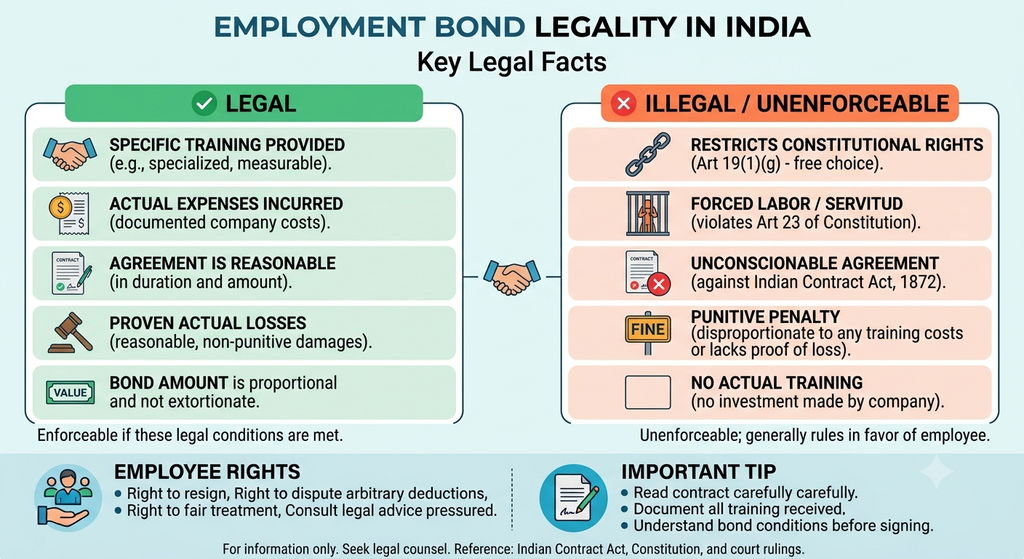
When Is a Bond Likely to Be Enforceable?
Courts generally look at these factors when deciding if a bond penalty is valid:
- Was there a genuine cost to the employer? (Training, certification, relocation, sponsorship — with actual invoices/proof)
- Is the penalty proportionate to that cost, or does it look like a punishment for leaving?
- Was the bond period reasonable? (1-2 years is generally seen as reasonable; 5+ years is often challenged)
- Did you sign it voluntarily, with the terms clearly explained — not buried in fine print or forced under pressure?
If your bond fails most of these tests, you have a strong case to contest it.
What Happens If You Resign Before the Bond Period Ends?
Here’s what typically happens in practice, step by step:
- HR will refer to your bond/offer letter and calculate the claimed penalty amount.
- They may withhold your full and final settlement, relieving letter, or experience letter until the amount is paid or resolved.
- You can negotiate. Many companies accept a pro-rata reduction — for example, if you served 8 months of a 12-month bond, you may only owe a fraction of the penalty, not the full amount.
- If the amount demanded seems unreasonable, you can formally dispute it in writing, citing that the penalty must reflect actual documented costs (ask HR/Finance for an itemized breakdown).
- As a last resort, unresolved disputes can go to the labour court or civil court, where the reasonableness test above will apply.
Can a Company Legally Withhold Your Relieving Letter?
This is one of the most common real-world problems employees face. Technically, a relieving letter isn’t a “right” guaranteed by a specific central law in the same way wages are — but withholding it purely as leverage to force bond payment is on shaky legal ground, especially if you’ve completed your notice period. Many employees successfully get relieving letters released by escalating in writing and referencing that continued withholding without valid cause can itself be challenged.
Practical tip: Always resign and communicate in writing (email), not just verbally. Keep a paper trail — it matters enormously if the dispute escalates.
How to Protect Yourself Before Signing a New Bond
If you’re evaluating a new job offer with a bond clause, ask these questions before signing:
- What exact amount is the penalty, and is it stated clearly in numbers (not vague language)?
- Is the penalty tied to an itemized training/relocation cost, or just a flat fixed figure?
- Is there a pro-rata reduction clause built in (penalty reduces the longer you stay)?
- What is the exact bond duration, and does it match the actual value being provided to you?
If a company refuses to clarify these points or the numbers seem arbitrary, that’s a red flag.
Frequently Asked Questions
Q: Is a 2-year employment bond legal in India?
A: Yes, a 1-2 year bond duration is generally viewed as reasonable by Indian courts, especially if tied to genuine training or certification costs.
Q: Can I resign without serving my bond period?
A: Yes — you can always resign. No company can legally force you to continue working. You may, however, be liable to pay a reasonable, documented penalty as per your agreement.
Q: What if my company demands an unreasonably high bond penalty?
A: You can contest it. Courts have repeatedly reduced or invalidated penalties that don’t reflect actual, proportionate losses to the employer.
Q: Can a company hold my salary or full and final settlement over a bond dispute?
A: This is a legal grey area and often challenged. Salary for work already done is generally protected separately from bond disputes — consult a labour law expert if this happens to you.
Q: Do employment bonds apply during probation period?
A: Some companies include bond clauses even during probation, especially for sponsored training programs. Always check your specific offer letter, as terms vary by company.
Reference
- https://www.majmudarindia.com/enforceability-of-employment-bonds-in-india/
- https://www.reddit.com/r/india/comments/jwv0pm/i_recently_found_out_that_bonded_labour_is/
Disclaimer: This article is for general informational purposes and reflects publicly available legal principles under Indian contract and labour law. It is not a substitute for personalized legal advice — if you’re facing an active bond dispute, consult a qualified labour law advocate with your specific documents.