

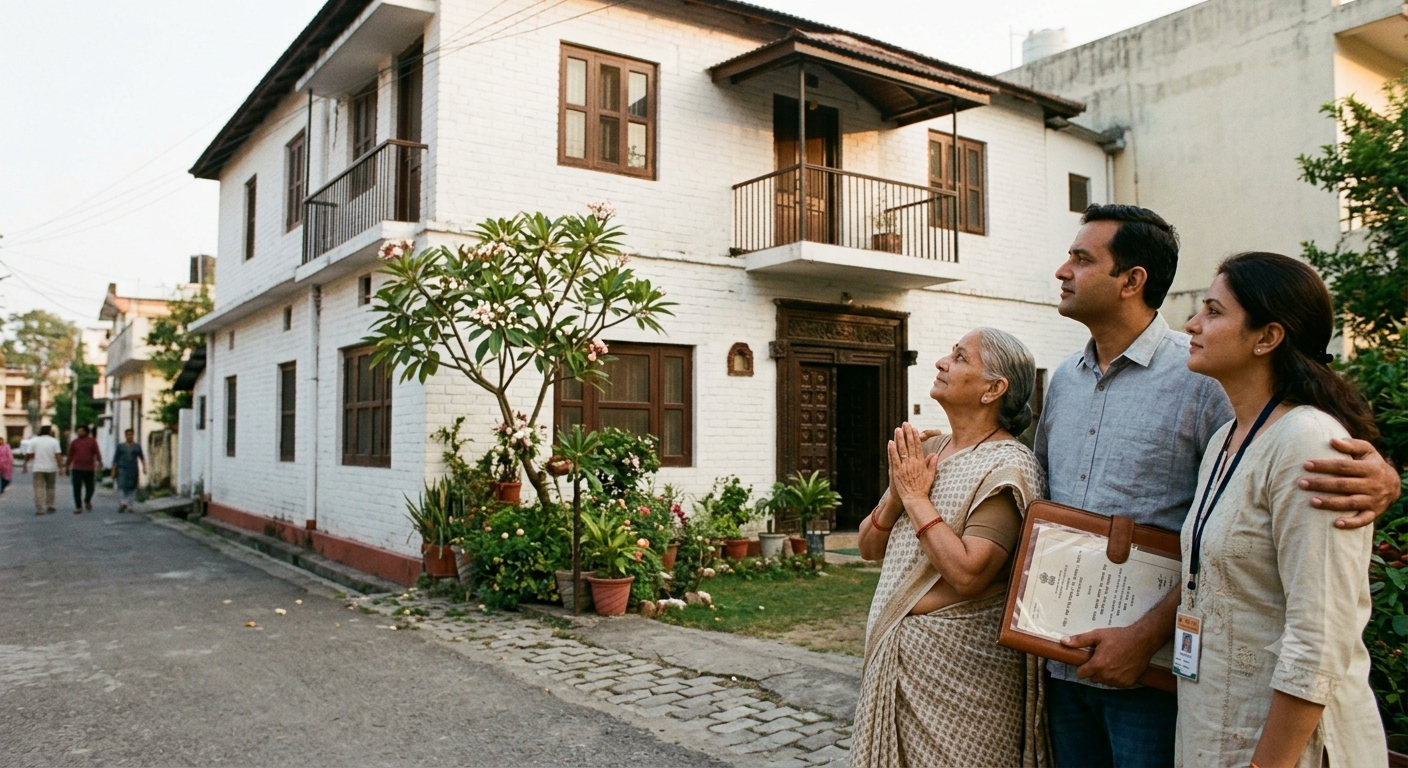
NRI Property Inheritance in India ; Inheriting property in India as an NRI? Here’s a simple, step-by-step guide to the paperwork, legal process, and taxes you need to know in 2026.
So you’ve inherited — or you’re about to inherit — property in India, and you live abroad. First of all, don’t panic. It sounds complicated, but once you understand the basic steps, it’s very manageable. Let’s break it down in simple terms.
Table of Contents
Can NRIs Even Inherit Property in India?
Yes, 100%. There’s no law stopping you from inheriting property in India just because you live abroad. Whether it’s a house, an apartment, commercial property, or even farmland — if it was left to you by a family member (through a will or by law), you can inherit it.
Here’s the one thing people often get confused about: buying property in India as an NRI has some restrictions (like farmland). But inheriting property doesn’t have those same restrictions. So if you inherited it, you’re generally fine.
The Process, Step by Step
Step 1: Figure Out Who the Legal Heirs Are
If the person who passed away left a will, that will usually decides who gets what. If there’s no will, Indian law decides based on religion — Hindus, Sikhs, Jains, and Buddhists follow one law; Christians and Parsis follow another; Muslims follow their own personal law. This sounds technical, but in practice, a local lawyer in India can tell you in one conversation which one applies to your family.
Step 2: Get the Right Certificate
This is the step people get stuck on most. Depending on your situation, you’ll need one of these:
- A Will + Probate (court approval of the will) — required in some big cities like Mumbai, Chennai, and Kolkata
- A Legal Heir Certificate or Succession Certificate — needed when there’s no will
Think of this as the “official proof” that you are indeed the rightful owner now. Without it, you can’t do anything else — no selling, no renting, nothing.
Step 3: Update the Property Records (Mutation)
Once you have your certificate, you need to go to the local municipal office and get the property records updated to show your name. This is called “mutation.” It’s basically telling the government, “Hey, this property is mine now.”
Step 4: Get a PAN Card
If you don’t already have an Indian PAN card, get one now. You’ll need it for almost everything going forward — paying taxes, selling the property, even renting it out. This is one of those things that’s easy to forget but causes big delays later, so do it early.
Step 5: Decide What to Do With the Property
Now comes the real decision — do you want to:
- Keep it (maybe visit occasionally or hold onto it)
- Rent it out (earn some income from it)
- Sell it (and possibly bring the money back to your country)
Each choice has different tax rules, which we’ll cover below.
What Documents Do You Actually Need?
Here’s your simple checklist:
- Death certificate of the person who passed away
- Will (if there is one) and probate/succession certificate
- Legal heir certificate (if there’s no will)
- Original property papers (sale deed, title documents)
- Property tax receipts
- Encumbrance certificate (proves no loans or legal issues are attached to the property)
- Your Indian PAN card
- Your passport, OCI/PIO card (to prove your NRI status)
- Power of Attorney, if someone in India is handling this for you
Helpful tip: If you can’t travel to India, you don’t have to. You can sign a Power of Attorney (POA) giving a trusted family member or lawyer in India the legal right to handle everything on your behalf — mutation, paperwork, even selling the property if needed. You just need to get this POA signed and stamped at the Indian embassy in your country.
Required Document Checklist
To complete the legal transfer and mutation of inherited property, assemble the following:
| Category | Primary Documents Required |
| Proof of Death & Title | • Original Death Certificate of the deceased • Original Sale Deed / Title Deed / Partition Deed of the property |
| Proof of Right | • Registered Will & Probate Order (if testate) • Legal Heir Certificate or Succession Certificate (if intestate) • No-Objection Certificate (NOC) from other legal heirs (if transferring to a single heir) |
| Property & Tax Records | • Latest Encumbrance Certificate (EC) • Latest Municipal Property Tax Receipts • Previous Mutation Order (Khata / Patta copy) |
| NRI KYC & Representation | • Copy of Passport / OCI Card / PIO Card • Indian PAN Card (Mandatory for property transactions/taxes) • Consular-attested Power of Attorney (if applicable) |
Do You Have to Pay Tax? (This Is the Part Everyone Worries About)
Let’s make this simple:
Just inheriting the property? No tax.
India doesn’t have an inheritance tax. So the moment you inherit the property, you don’t owe anything to the government. That part is genuinely stress-free.
Selling the property later? Yes, some tax applies.
If you decide to sell it down the road, you’ll need to pay capital gains tax on the profit. Here’s the good part — since you inherited it, the “starting value” for tax purposes is based on what the original owner paid for it (not zero), which usually works in your favor. Most inherited properties also qualify for long-term capital gains treatment (which is taxed at a lower rate), because the “ownership clock” started when your family member originally bought it, not when you inherited it.
One thing to know: when an NRI sells property in India, the buyer is required to deduct tax (called TDS) before paying you, and NRIs often face a higher TDS rate than local sellers. But here’s a useful trick — you can apply for a lower TDS certificate from the Income Tax Department before the sale, so less tax gets deducted upfront, and you don’t have to wait for a refund later.
Want to send the sale money abroad? You can — up to a limit.
If you sell the property and want to transfer the money to your country, you’re allowed to send up to USD 1 million per year out of India, as long as your paperwork and taxes are in order.
Renting it out instead? That income is taxable too.
If you keep the property and rent it out, the rental income is taxable in India, and your tenant is usually required to deduct tax before paying you rent.
Worried about being taxed twice (once in India, once in your country)?
Most countries where NRIs live (USA, UK, UAE, Canada, Australia, etc.) have a tax treaty with India called DTAA. This means you can usually get credit for the tax you already paid in India, so you’re not taxed twice on the same money.
Mistakes People Commonly Make (Avoid These)
- Waiting too long to update the property records — do the mutation early, don’t leave it for “later”
- Not getting a PAN card right away — this delays everything else
- Assuming probate isn’t needed — check your specific city/state, because some places legally require it
- Not applying for the lower TDS certificate before selling — otherwise you’ll overpay tax and have to claim it back
- Forgetting about the tax treaty (DTAA) — this can save you from paying tax twice
Quick Answers to Common Questions: NRI Property Inheritance in India: Simple Guide to Process, Documents & Taxes (2026)
Do I have to pay tax just for inheriting property in India?
No. Inheriting property is tax-free in India. Tax only comes into play if you later sell it.
Can I sell farmland I inherited in India, even though NRIs can’t buy farmland?
Yes, you can sell it — but usually only to a resident Indian citizen, not to another NRI.
Do I need to go through probate?
It depends on where the property is and whether there’s a will. Some cities require it by law; elsewhere it’s strongly recommended to avoid future disputes.
Can I handle all of this without flying to India?
Yes — a Power of Attorney lets someone you trust in India manage everything for you.
How much money can I send abroad after selling?
Up to USD 1 million per financial year, as long as your documents and tax filings are proper.
Reference
- https://www.icici.bank.in/nri-banking/nriedge/nri-articles/navigating-nri-inheritance-laws-in-india-for-real-estate
- https://www.rbi.org.in/commonman/english/scripts/Notification.aspx?Id=1175
Disclaimer: This article is written for general understanding based on publicly available information as of 2026. Every family’s situation is a little different, so please talk to a qualified CA or lawyer before making any big decisions.