

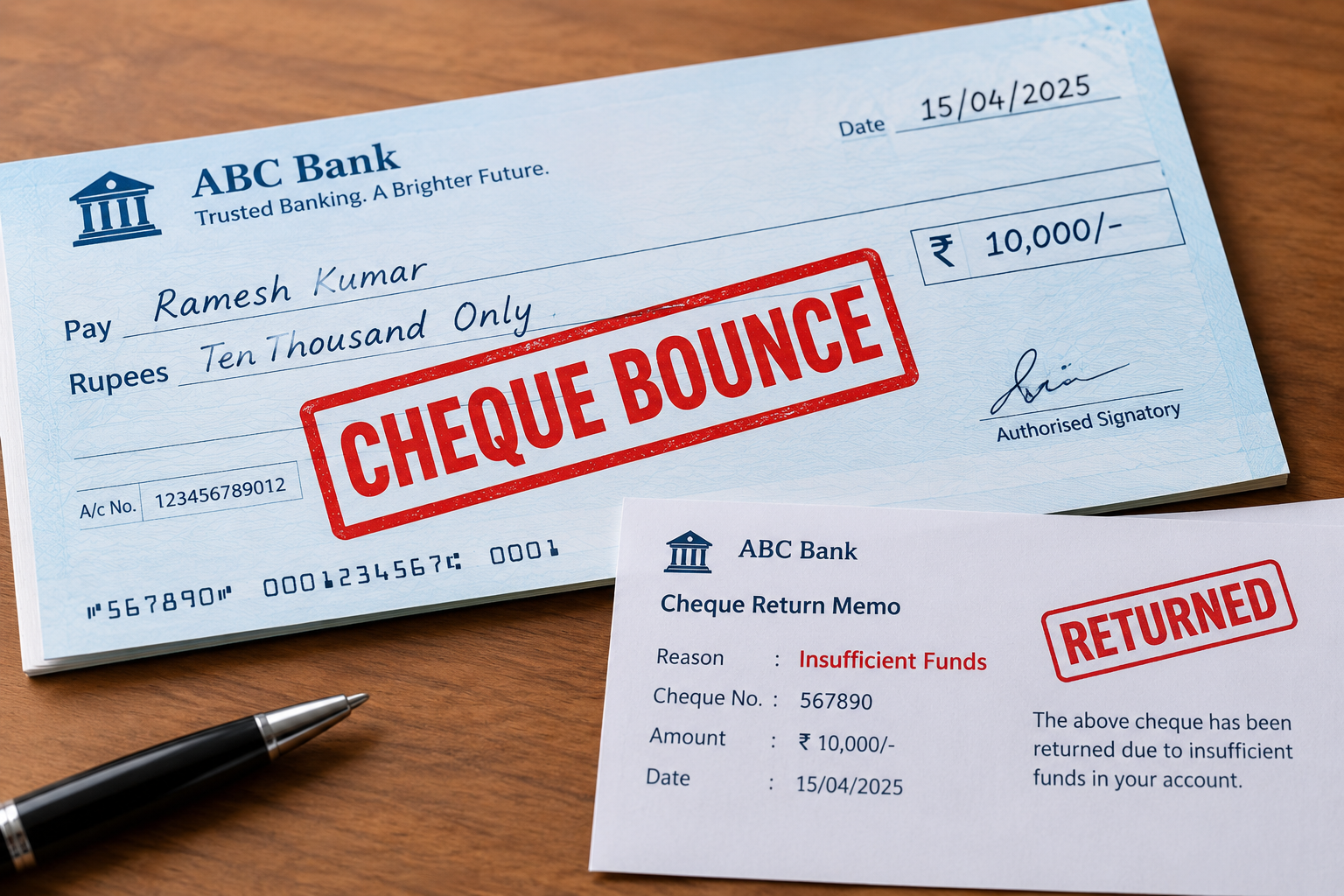
Cheque Bounce Case Under Section 138: A cheque is often treated as one of the simplest ways of making a payment. You receive a cheque, deposit it with your bank, and expect the money to reach your account. But what happens when the cheque is returned unpaid?
That is where things can become legally serious.
A cheque bounce under Section 138 of the Negotiable Instruments Act, 1881 can lead to a criminal complaint, statutory legal notice, court proceedings and, in appropriate cases, financial and criminal consequences. For an individual who has never dealt with litigation, receiving a Section 138 legal notice can be extremely stressful. The situation can become even more complicated when the cheque was issued by a company and directors, officers or other persons associated with the company are also named in the proceedings.
I have seen this issue from a slightly different perspective.
I have personally never faced a cheque bounce case in my individual capacity. However, the subject affected me personally during my tenure on the board of a BSE-listed company. During that period, certain company cheques were dishonoured, and I received notices under Section 138 of the Negotiable Instruments Act in connection with multiple cheque bounce matters.
That experience made me realise something important: receiving a Section 138 notice does not necessarily mean that every person named in it is automatically criminally liable. When a company is involved, the role, responsibility and position of each individual can become extremely important. Section 141 specifically deals with offences committed by companies and the circumstances in which persons responsible for the conduct of the company’s business may be proceeded against.
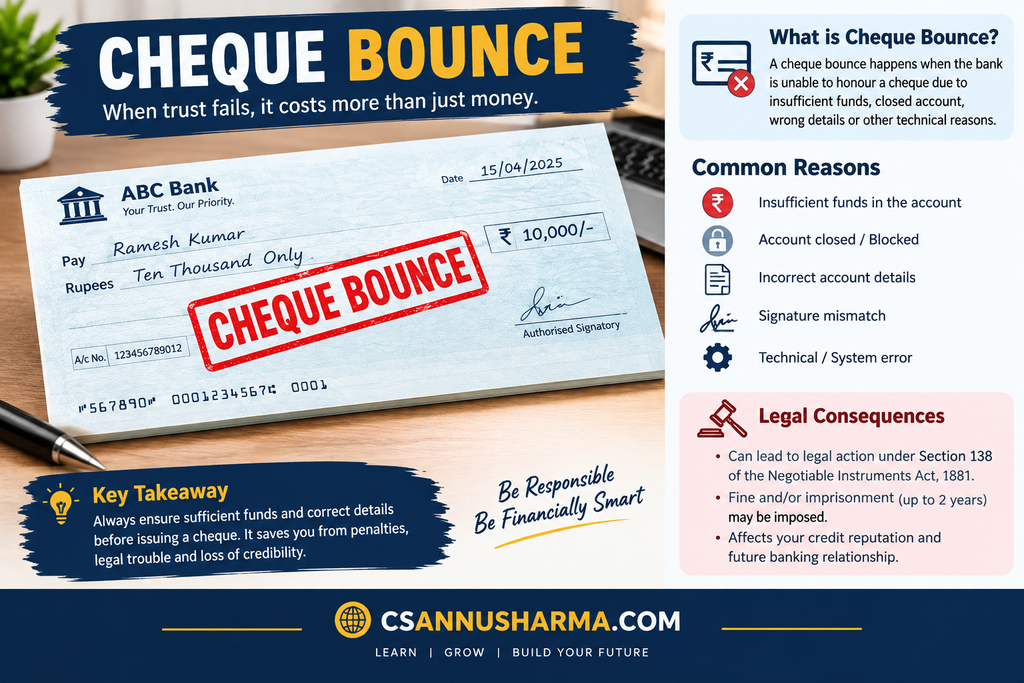
This is also why you should never ignore a cheque bounce notice.
There are specific statutory timelines involved. Broadly, Section 138 requires the cheque to be presented within its applicable validity period, followed by a written demand notice within 30 days of receiving information regarding dishonour. The drawer then gets 15 days from receipt of the notice to make payment. If the statutory requirements are satisfied and payment is not made, the complainant may proceed with a complaint before the appropriate court.
The potential punishment under Section 138 can extend to imprisonment up to two years, fine up to twice the amount of the cheque, or both, subject to the requirements and facts of the particular case.
Table of Contents
Cheque Bounce Case Under Section 138
In this 2026 guide to cheque bounce cases, I will explain the process in practical language—starting from what happens when a cheque is dishonoured, what a Section 138 notice means, how to respond to a cheque bounce legal notice, what happens after the notice period, how a cheque bounce case in India proceeds before the court, and what directors and company officers should understand when a company cheque is involved.
I will also discuss common questions people search for, including “what to do after receiving a cheque bounce notice,” “Section 138 notice reply,” “cheque bounce case punishment,” “cheque bounce case procedure,” “how to defend a cheque bounce case,” “Section 138 limitation period,” “director liability for company cheque bounce,” and “how to settle a cheque bounce case.”
This is not merely a textbook explanation of Section 138. I will also share the practical lessons I learned from being indirectly involved in such matters and explain the steps that can help you respond calmly, document your position and understand your legal options before the matter goes further.
The objective is simple: if you receive a cheque bounce notice, don’t panic and don’t ignore it. Understand the law, understand your role, preserve the documents, and take the right legal advice at the right time.
What is a cheque bounce under Section 138?
In simple terms, Section 138 deals with dishonour of a cheque issued for the discharge, wholly or partly, of a legally enforceable debt or other liability, subject to the statutory conditions being fulfilled.
The law creates a specific process.
A typical matter may look like this:
Cheque issued → cheque presented → cheque dishonoured → bank return memo → legal notice → 15-day payment period → complaint before Magistrate → court proceedings
The important point is that a cheque bouncing does not mean that a Section 138 offence is automatically complete the moment the bank returns the cheque.
The statutory requirements have to be examined carefully.
Section 138 currently provides for punishment that may extend to two years’ imprisonment, or fine up to twice the amount of the cheque, or both, subject to the requirements of the provision being satisfied.
The Act also contains important provisions dealing with presumptions, company liability, jurisdiction, trial procedure, interim compensation and compounding.
Why is a Section 138 legal notice so important?
If you receive a cheque bounce notice under Section 138, do not put it aside thinking that it is merely a lawyer’s letter.
The notice is part of the statutory mechanism contemplated by Section 138.
Broadly, once the payee receives information from the bank regarding dishonour, the demand notice has to be issued within 30 days. The drawer then gets 15 days from receipt of the notice to make payment of the cheque amount. If the payment is not made within that period, the cause of action for filing the complaint arises, subject to the statutory requirements.
There is then a further limitation period governing the filing of the complaint under Section 142.
This is why dates matter enormously.
When you receive a notice, immediately note:
- Date printed on the cheque
- Date of presentation
- Date of dishonour
- Date of bank return memo
- Date of legal notice
- Date of dispatch
- Date of delivery/receipt
- Amount demanded
- Date on which the 15-day period expires
- Whether there were earlier notices or presentations
A lawyer examining a cheque bounce case will usually want to see this chronology before giving an opinion.
What should you do after receiving a Section 138 notice?
The first rule is simple:
Do not ignore it.
The second rule is equally important:
Do not send an emotional reply without examining the underlying transaction.
Before responding, collect the complete record.
Depending on the circumstances, this may include:
- Copy of the cheque
- Bank return memo
- Legal notice
- Envelope and delivery details
- Agreements
- Invoices
- Purchase orders
- Ledger statements
- Bank statements
- Emails
- WhatsApp or other business communications
- Payment records
- Settlement discussions
- Previous correspondence
- Board resolutions, where relevant
- Company records, where the cheque was issued by a company
Your lawyer should ideally understand the entire transaction rather than only the cheque.
That is because a cheque does not exist in isolation.
The underlying question may be whether there was a legally enforceable debt or liability, whether the cheque was issued towards that liability, whether payment had already been made, whether the cheque was being used as security, whether the amount claimed is correct, and what exactly happened between the parties.
Does receiving a Section 138 notice mean you have lost the case?
No.
A legal notice is not a court judgment.
It is a formal demand and an important stage in the statutory process.
However, it should also not be treated casually.
The response must depend upon the facts.
For example, a person may have a genuine defence because:
- There was no legally enforceable debt;
- The amount had already been paid;
- The cheque was issued for a different purpose;
- The cheque was misused;
- The underlying transaction was cancelled;
- The amount claimed is disputed;
- The cheque was issued in circumstances that require further examination;
- The person receiving the notice was not the drawer;
- In a company case, the individual named may dispute the statutory basis for personal liability.
These are factual and legal questions. They should be supported by documents and evidence rather than simply asserted in a reply.
What if the cheque was issued by a company?
This is where matters can become considerably more complicated.
Suppose ABC Limited issues a cheque and the cheque is dishonoured.
The legal notice may be addressed to:
- ABC Limited
- Managing Director
- Director
- Authorised Signatory
- Company Secretary
- Other officers
But the legal position concerning each person has to be examined separately.
Section 141 provides the statutory framework for offences by companies. The provision refers to persons who were in charge of and responsible for the conduct of the business of the company, while also containing a separate provision concerning consent, connivance or neglect.
The Supreme Court has repeatedly considered the requirements for invoking such vicarious liability.
In a 2024 Constitution Bench decision, the Supreme Court considered, among other questions, whether complaints under Section 141 need specific averments concerning the accused person’s role and whether a director can simply be presumed to be responsible for the company’s business merely because of the designation of director.
This is why a person who receives a notice merely because he or she was associated with a company should not assume either that liability definitely exists or that the notice can safely be ignored.
The actual role matters.
Company Secretary and director liability in cheque bounce cases
My own experience made this issue particularly relevant to me.
Being associated with a company does not necessarily mean that a person was responsible for every operational decision taken by the company.
A Company Secretary may have statutory and compliance responsibilities, but the precise facts of the case, the person’s role, the allegations in the complaint, the company’s internal structure and the circumstances surrounding the cheque can all become relevant.
Similarly, the title “Director” by itself should not be treated as the end of the legal analysis.
The Supreme Court has recognised that vicarious liability under Section 141 is a statutory liability and that the requirements of the provision must be satisfied. In a December 2024 judgment, the Court also discussed circumstances involving directors or employees who had severed their connection with the company and the relevance of consent, connivance or neglect under Section 141(2).
Therefore, if you are a director, Company Secretary or officer who receives a Section 138 notice relating to a company’s cheque, take the notice seriously but examine why you have been named and what allegations are actually made against you.
Section 138 cheque bounce case procedure
A simplified Section 138 case may proceed through the following stages.
Step 1: Cheque is issued
The cheque is issued towards an alleged legally enforceable debt or liability.
Step 2: Cheque is presented
The payee presents the cheque for payment within the applicable period of validity.
Step 3: Bank dishonours the cheque
The bank returns the cheque unpaid and issues a return memo stating the reason for dishonour.
Step 4: Statutory demand notice
Subject to Section 138’s requirements, the payee sends a written demand notice within the prescribed 30-day period after receiving information regarding dishonour.
Step 5: Fifteen-day period
The drawer gets 15 days from receipt of the notice to make the demanded payment.
Step 6: Complaint
If the statutory conditions are satisfied and payment is not made, the complainant may file a complaint under Section 138 within the limitation prescribed by Section 142, subject to the Act’s provisions concerning condonation of delay.
Step 7: Court proceedings
The matter then proceeds before the competent Magistrate in accordance with the applicable procedure.
The Negotiable Instruments Act contains special provisions relating to summary trials, evidence by affidavit, service of summons and other procedural matters.
What is the punishment for cheque bounce under Section 138?
One of the most frequently searched questions is:
“What is the punishment for cheque bounce in India?”
Section 138 provides for:
Imprisonment up to two years, or fine up to twice the amount of the cheque, or both.
But it is important not to misunderstand this provision.
Every cheque bounce case does not automatically result in imprisonment.
The outcome depends on the facts, evidence, statutory compliance, proceedings before the court, defence available to the accused, settlement possibilities and the orders passed by the court.
The practical objective in many cases may involve resolving the underlying monetary dispute through legally appropriate means rather than allowing litigation to continue indefinitely.
Section 139: Presumption in favour of the cheque holder
Another important provision is Section 139 of the Negotiable Instruments Act.
The law creates a presumption in favour of the holder that the cheque was received for the discharge, wholly or partly, of a debt or other liability, unless the contrary is proved.
This is one reason why a Section 138 defence should not be based simply on saying:
“I did not owe the money.”
The defence needs to be considered in light of the statutory presumptions and the evidence available in the case.
The accused’s lawyer should examine the transaction, documents, circumstances in which the cheque was issued, correspondence between the parties and the complainant’s evidence.
Can a cheque bounce case be defended?
Yes, but the appropriate defence depends entirely on the facts.
There is no universal “cheque bounce defence” that works in every case.
Possible issues that may require examination include:
- Whether a legally enforceable debt existed;
- Whether the cheque was issued towards that debt;
- Whether the statutory notice was properly issued;
- Whether the notice was issued within the prescribed period;
- Whether the payment period had expired before filing;
- Whether the complaint was filed within limitation;
- Whether the person has been properly impleaded;
- Whether Section 141 requirements have been met in a company case;
- Whether the amount claimed corresponds with the actual liability;
- Whether the cheque was issued as security and, if so, what the underlying circumstances were;
- Whether the underlying liability had already been discharged or altered;
- Whether there are documents contradicting the complainant’s version.
The important word here is evidence.
A defence becomes much stronger when it is supported by contemporaneous documents.
What if there are multiple bounced cheques?
This is particularly important in 2026.
The Supreme Court in Sumit Bansal v. MGI Developers and Promoters, decided in January 2026, held that a separate cause of action can arise from each dishonoured cheque when the statutory sequence relating to that cheque is completed. The Court held that the fact that several cheques arose from the same underlying transaction does not automatically merge them into a single cause of action.
This is an important development for anyone dealing with multiple cheque bounce notices.
For example, imagine that five cheques were issued under one commercial arrangement and each was presented and dishonoured at different times.
It would be unsafe to assume that there can only be one Section 138 proceeding simply because the cheques relate to one transaction.
The exact facts and statutory compliance for each cheque must be examined.
Can a cheque bounce case be settled?
Section 147 of the Negotiable Instruments Act provides that offences under the Act are compoundable.
This means settlement can be an important practical consideration in appropriate cases.
However, settlement should be documented properly.
If parties reach an understanding, the terms should clearly address matters such as:
- Total settlement amount
- Payment schedule
- Mode of payment
- Treatment of pending complaints
- Withdrawal/compounding procedure
- Consequences of default
- Whether all claims are being settled
- Treatment of multiple cheque cases
- Responsibility for court appearances and documentation
A verbal assurance that “the matter will be closed” is not something I would recommend relying upon.
Get the settlement properly documented and place it before the appropriate court where necessary.
Interim compensation in cheque bounce cases
The Negotiable Instruments Act also contains Section 143A, which gives the trial court certain power to direct interim compensation in specified circumstances.
This is another reason why a person facing a Section 138 complaint should take the proceedings seriously from the beginning.
Do not wait until several hearings have passed before understanding the case.
Get the complete complaint, documents, cheque, return memo, notice and supporting material examined by a lawyer familiar with cheque dishonour litigation.
Common mistakes people make after receiving a cheque bounce notice
From a practical perspective, these are some of the mistakes worth avoiding.
1. Ignoring the notice
This is probably the biggest mistake.
Even if you believe the claim is completely false, do not assume that ignoring the notice will make the problem disappear.
2. Sending an angry reply
A legal reply should deal with facts and law.
Personal accusations, emotional language and unnecessary allegations can create additional problems.
3. Admitting liability without understanding the consequences
Be careful about what is admitted in writing.
A statement made casually over email or WhatsApp can later become part of the record.
4. Destroying or deleting communications
Preserve emails, messages, agreements, invoices, bank records and other documents.
5. Assuming a director is automatically liable
Company cases require a careful examination of Section 141 and the allegations against each individual.
6. Missing dates
Cheque bounce litigation is heavily dependent on statutory timelines.
Maintain a written chronology from day one.
7. Treating settlement discussions casually
If you are negotiating, document the terms clearly.
What documents should you keep ready?
If you receive a Section 138 notice, create one folder—physical or digital—and put everything into it.
I would suggest keeping:
Financial documents
- Bank statements
- Ledger
- Invoices
- Payment receipts
- Account statements
Cheque-related documents
- Copy of cheque
- Return memo
- Deposit details
- Bank correspondence
Legal documents
- Section 138 notice
- Postal records
- Delivery proof
- Previous notices
- Court complaint, if filed
- Summons/orders
Business records
- Agreement
- Purchase order
- Board resolutions
- Minutes, where relevant
- Emails
- Letters
- WhatsApp/business communications
If the matter involves a company, also preserve documents showing the individual’s actual role and responsibilities during the relevant period.
What if the cheque was issued as security?
The phrase “security cheque” is frequently used in cheque bounce disputes.
But simply describing a cheque as a “security cheque” does not, by itself, resolve the legal question.
The real issue is what liability existed when the cheque was presented and whether the statutory ingredients of Section 138 were satisfied.
Therefore, if your defence is that the cheque was given as security, your lawyer should examine the underlying agreement, payment history, correspondence and the circumstances in which the cheque was issued and presented.
Do not rely on a single label.
Look at the complete transaction.
Should you pay after receiving a Section 138 notice?
There is no universal answer.
If the underlying amount is genuinely due and you are in a position to resolve the dispute, payment or settlement may be worth considering.
If the claim is disputed, fraudulent, inflated or unsupported, the appropriate response may be different.
This is where individual legal advice becomes important.
Before making a substantial payment, understand what exactly will happen to the legal proceedings and whether the payment fully resolves the dispute.
If there are multiple cheques or multiple proceedings, make sure the settlement covers the intended matters.
A practical checklist after receiving a cheque bounce notice
Here is the checklist I would keep handy:
Day 1
☐ Read the entire notice
☐ Note the cheque number
☐ Note the cheque amount
☐ Note the dishonour date
☐ Check the bank return memo
☐ Identify the alleged underlying liability
☐ Preserve all correspondence
Next step
☐ Consult a lawyer experienced in Section 138 matters
☐ Prepare a chronology
☐ Collect agreements and invoices
☐ Check bank payments
☐ Examine whether the statutory timelines have been followed
☐ If a company is involved, examine the role of every person named
Before sending a reply
☐ Verify every factual statement
☐ Avoid unnecessary admissions
☐ Avoid emotional language
☐ Address the allegations specifically
☐ Preserve proof of dispatch and delivery
If a complaint has already been filed
☐ Obtain the complete complaint and annexures
☐ Check the summons
☐ Understand the next court date
☐ Discuss bail/bond and appearance requirements with your lawyer where applicable
☐ Examine possible defence and settlement options
☐ Do not miss court dates without appropriate legal advice
Final thoughts: Don’t panic, but don’t ignore a cheque bounce notice
A Section 138 cheque bounce case can be stressful, particularly when the notice arrives unexpectedly.
I know this because, although I was not personally the drawer of the dishonoured cheques, I experienced the impact of such proceedings during my association with a BSE-listed company.
What stayed with me was that cheque bounce litigation is not simply about whether a cheque bounced.
There can be questions about the underlying debt, the statutory notice, limitation, the role of individuals, company liability, documentary evidence, multiple cheques and the manner in which the matter is handled after the notice is received.
And this is where preparation matters.
If you have received a Section 138 legal notice, the worst response is usually to panic or ignore it.
Read it carefully.
Record the dates.
Collect the documents.
Understand the transaction.
Identify exactly why you have been named.
Then take informed legal advice.
The law provides a structured process, and understanding that process can make an otherwise frightening situation much easier to navigate.
Frequently Asked Questions About Cheque Bounce Cases
What is Section 138 of the Negotiable Instruments Act?
Section 138 deals with dishonour of a cheque issued towards a legally enforceable debt or other liability, subject to the statutory conditions contained in the provision.
How long do I have to respond to a cheque bounce notice?
The statutory framework gives the drawer 15 days from receipt of the notice to make payment of the cheque amount. The notice itself is generally required to be issued within 30 days of the payee receiving information regarding dishonour.
What is the punishment for cheque bounce in India?
Section 138 provides for imprisonment of up to two years, or fine up to twice the cheque amount, or both, subject to the statutory requirements and facts of the case.
Can a director be prosecuted for a company’s cheque bounce?
A director is not simply liable because of the title “director.” Liability in a company cheque case has to be examined under Section 141, including the person’s role and the allegations establishing the statutory basis for vicarious liability.
Can multiple cheque bounce cases arise from one transaction?
Yes. The Supreme Court held in January 2026 that separate causes of action can arise from separate dishonoured cheques when the statutory sequence is independently completed.
Can a cheque bounce case be settled?
Yes. Section 147 makes offences under the Negotiable Instruments Act compoundable, subject to the applicable legal procedure.
Should I reply to a Section 138 notice?
A notice should not be ignored. Whether and how to reply depends upon the facts, documents, alleged liability and legal position. A properly considered response can be important, particularly where the allegations are disputed.
Reference
Important Disclaimer
This article is intended for general legal information and educational purposes only. It is not a substitute for legal advice from an advocate who has examined the facts and documents of your particular case.
Cheque bounce matters can involve strict statutory timelines and fact-specific issues. The law can also change through legislative amendments and judicial decisions. Before taking action on a Section 138 notice, complaint or court proceeding, obtain professional legal advice based on your individual circumstances.